Showing posts with label behavior. Show all posts

Wednesday, December 12, 2012

Chester- the Good, the Bad, the Unknown

Awww, Chester on a good day. My little buddy!

Chester is my little buddy. So sweet, so empathetic, rather cautious but always eager to see what's up and hang out with me. On the other hand, sometimes Chester has bad days. Days were he does not wish to cooperative on any level, and should he actually decide to, say, step-up, you should put him down as soon as possible. From experience, I can safely say he will NOT be satisfied on your hand for much longer than 3.5 seconds. His Maori yell, as I call it, is usually used extensively during these days, most often accompanied by beak charging and/or banging. Sometimes these bad days last for weeks or even a month or two. Sometimes not. Hard to say.


I would like to point out, though, that both of my ekkies are extremely polite about biting. Chester screams, beak bangs, even beak bangs with his beak open, and occasionally does a quick dose of beak pressure, but I have only once, ONCE! ever been actually bitten. That would be the day Clementine came home. Clearly  he knew something was up, though he obviously had not been anyway near her at that point- and I have to wonder is he thinks he overreacted, since he is know friends with her. Anyway. Chester really amazes me with how polite he is. If he does not want you, he will lean so far back he hangs upside down from his perch, or fly off with such force and speed he inevitably rams into something (not good), but he just does not favor biting.


I am not complaining- who likes being bitten? As is only polite on my part, I do my best to avoid irritating him any further than he already is with..... well, whatever it is that irritates him during these times. This means during his bad days I may never pick him up (though I always give the option), instead I just offer the occasionally treat (sometimes even that he does not want) and open his cage door so he can come out to play on his cage if he so chooses. Talk to him, but not too close. Just let him be, and give him what I can.


When Chester is having a good day, he can be very sweet. Not to everyone, but to me and a few other select people he has learned over time to trust. After many weeks of not sweet, he has become sweet again this December. I am thinking of it as an early Christmas gift. So nice to have back my friendly feathered beaver! And as a last note, speaking of feathers: his improve each year- month by month there are ups and downs, but year by year they are better and better. He is quite green now, and I am still holding out hope for a fully green boy in the future, at least for part of the year. Already many of these pictures look fully green, since it his just his lower belly where down still shows. So he is what I call "Facebook fully-feathered." And that is better than nothing!

Chester: a bird with a mission.
To the top!

The view! Ah, the view!
Such a lovely place to fluff and relax.
My work is done.

Monday, December 3, 2012

Dr. Guess-Who-Clementine!

Guess who you should not ask to help
with Christmas cards?

Clementine is doing very well, now a year since I adopted her. Her diet was about average when I got her, but she has slowly become a much better eater, not just with new foods but with new ways of preparing them and, therefore, new food textures. She no longer shuns mushy food, which has greatly increased her sweet potato, cooked mash, and squash intake! She was fairly well adjusted when I got her, and has remained so. Very rarely, or rather never, is she in a bad mood, and shows her age less than Lola and Miss Patty. Yes, she has some joint inflammation and a bit of plucking under one of her wings, but quite good really. All in all, Clementine is still just as fabulous as ever. My sanity, eh, not so much. Clementine is a talented mimic. Really talented. So talented, in fact, that she has become my resident household ghost.


In general, she leaves actual talking to the other parrots. No, Clementine specializes in those subtle noises that generally accompany having someone else in the house- distance voices that are incredibly realistic, cars driving up, doors creaking, even people walking around. She will do this if you are standing next to her, or if you are in the next room or upstairs, so she is certainly not a closet talker  She just has a deep appreciate for the subtle. One that might, in fact, drive me insane as I check the door for the 5th time thinking it is Gwen whining to come in. Or jump once again when she uses her most human of voices at a moment you are least expecting. I think she likes making me jump. She must. Because while I cannot fully describe why her ghost talking is so much more, well, rattling, than any of my other parrots- trust me, it is. And she practices a lot. So she is only getting better.


Really, what was wrong with a simple, loud and clear, hello? Or the telephone ringing? Or even the dogs barking,as Alasdair is doing outside in the above picture. Nice, loud, simple noises. Conversations like frank. Basic stuff.


Jokes aside, to (for once) be perfectly honest, Clementine's noises get very little reaction from me, hardly any, aside from the door checking, which rarely works any more. They do make me notice, but usually when I am not in the room, and only because of how good they are, rather than because I think robbers have actually broken into the basement- my dogs are way to bark happy to miss an event like that, it is all they live for, that and dinner anyway. And I do not think looking up from my knitting counts as enough of a reaction, either. So I think she has just developed a fascination with sounding as good as she can for her own interest, rather than mine. Although it does thoroughly confuse the occasional guest I get, which is very frustrating for them, not being as sedate as I am when it comes to odd noises from parrots. But then, I enjoy that quite a bit too, so I guess we are just both terrible.


Saturday, November 17, 2012

Linus is a new man! (er, parrot)

When I got Linus back several years ago, he had liver damage, his preen gland was malfunctioning, and he had started plucking. He also was extremely anxious. Since then, he has improved, thanks in no small part to his adopted mother Ava, but he still was a very anxious fellow. Rarely did he look relaxed- if ever I saw a parrot with an anxiety disorder, it was him. After Ava passed away this past Spring, I moved Linus into my bedroom, away from the other parrots. That helped, certainly, since I was with him a fair amount, he was in a very calm environment, but more importantly (as I did spend a lot of time with him in the bird room, too) he was with me when I was relaxing and/or sleeping, and relaxation is catchy. A bit like yawning, I suppose. But still he was extremely jumpy almost all the time.

(Just a note, this picture was not taken when he was upset-
that would not be the time to shove a camera in his face.
It does show how I often found him, though.)

This summer I did another round of herbal treatments for his liver, and this time, instead of just helping his liver, they also almost totally stopped the anxiety. Really,  about a two weeks in I noticed some improvement, and a week later it was very obvious to everyone. His panic attack moments are quite rare now, and he is now showing more of his personality, playing, eating better, and demanding attention! Instead of thrashing around when I put the food dish in (even though he has outside access doors and was in other ways semi-tame) he would just wait for me to finish, and dive in. No more slamming into the bars when the door to the room opened. And plenty of time spent relaxed, with his cheek feathers fluffed out, his crest at "half mast", and singing softly. Or loudly. He does love making noise. Seriously a lot of noise.


Now, when he is afraid of something, or wary, instead of becoming what can only be described as hysterical, he visibly makes a decision to abort, by leaning back, backing away slowly, or as a last resort flying off, or even occasionally stand his ground and hiss.


I am really amazed at his progress, up until now I just wondered if he would ever be relaxed and happy, let alone really tame. I suppose his amygdala (part of the brain that handles stress response) finally decided he was healthy enough to calm down! I have felt rather guilty about him for quite a long time, since he came back in fact; as it would be for any parrot caretaker, it was upsetting for me not to be able to help him more. I could rarely even take him to another room, or even outside in a carrier, something he did very much seem to enjoy, as he loves sitting in the sun. I really had to catch him on a very good day to do much with him. And living with that can be hard, you have to remind yourself often you are not a failure, and just keep trying everyday. While Linus might have seemed like a"difficult" parrot, much too hard for a first time caretaker, in actuality, anxiety aside, he was quite easy to tame and make friends with. That is why I say what you need most when taking on a rehome is patience and some good parrot books to help you through, not necessarily a degree in parrot wrangling. 

He is even brave enough to admit his well-loved 
cage cover is bright pink with monkey faces. 

And after all that, I now have a little buddy- happy, calm, and a (sometimes annoying) attention hog!

Tuesday, November 13, 2012

Miss Claudia with a bit less

Two things: one, don't worry, the white rope is much to big to choke her,
and Two, Claudia loves her platform from 
Things for Wings you see in the background! It has really helped her chronic foot issues.

When I adopted Miss Claudia she was fully feathered, and beautifully so. Since her case of asper 2 years ago, though, which started an intense bout of plucking, her plumage has taken quite a beating. At times she has had all of her feathers save for those on her neck, which she keeps bare, and at times she has been much closer to nude. Right now she is somewhere in the middle. it is a bit harder than, say, Chester, who goes through similar ups and downs (he is doing fairly well now, incidentally) as he started plucking long before I got him. Despite her current appearance, though, I really feel pretty good about Claudia right now, mostly because she seems to feel really good herself!


Claudia has never been very healthy, and was quite thin when I got her, having been force weaned and not in a home that noticed the problem, rather, they just assumed she was boring and stand-offish. Likely owing to those problems, while she is confident in many ways, she is also quite a fragile bird, so it takes quite a long time after an "incident" or illness to get her back on track: playing, foraging, exploring and flying- even eating enough on her own. So I admit I was always a bit worried she was a "good candidate", if there is such a thing, for plucking or feather destruction, and just hoped I could prevent it. Not that I thought about that too often, since a happy and healthy Claudia could easily be confused with a caique on growth hormones that fell in a paint pot. Seriously. Compare that to when she is not doing well, and just sits, or sits and begs, very little else. And with an apparently weak immune system, she can get sick rather easily.


This past Spring, she was doing pretty well, then this summer she took a down turn, and late summer starting plucking again. However, I think the plucking may have stopped again now, or at least very much slowed, but more importantly, she is eating well, everything and a lot of it, and is playful, friendly, game for just about anything, and back to her toy-destructive self. So I am thrilled!


One of the ways I encourage her to get back to playing is through foraging. I know she likes simple chippable items and things easily shredded, at least when she is in the mood to play. Right now, I could hang a toy on the moon and she would fly up there just to show it who is boss. When she is not interested, though, I make sure all of her toys are as enticing as I can, and place them almost in her way by her favorite perching spots. I also make sure all of them have a way to hide or place treats in/on them. Once she is reliably getting the treats, I starting hiding them in the toys more thoroughly, making them harder to reach. Eventually, as is the case now, she remembers how much fun destroying a toy "just because" is, and will go to town destroying them, even dropping some of the treat in the process. In fact, just taking out one of the treat containers is enough to get her to go to her toys and start destroying. And as anyone with parrots can tell you, very little is as satisfactory as coming into the room to find piles of wood chips and shreds of toys lining the cage bottom!


Currently, Claudia's favorite toy, for foraging and otherwise, is this coconut head by Planet Pleasures. You can slip nuts in the holes the ropes come out of, although by now several of the holes have no ropes in them, or even coconut fiber around them to dig through. Pretty soon, there will be nothing but a shell left!


Oh, and just to note, I did finish my to-do list from the other day! Yay!

Sunday, July 22, 2012

Foraging Bite


Today's work! The dry mix foraging bundles for the week. Brown thick paper for the big birds, brown tissue paper for the tiels, and white paper for the quakers. They are all filled withe appropriate amount and mix of my dry stuff- grain mix, big birds dry mix, seeds, nuts, etc. Just put one somewhere in the cage, and it is not only an "instant" meal but great foraging.

As you can see, I start with a rectangular piece of paper, (although this one was a bit too fat and not quite long enough to be optimum).....


then fold in the two long sides, before twisting the ends tightly around......


and wrapping them to one side and loosely knotting.


Done!


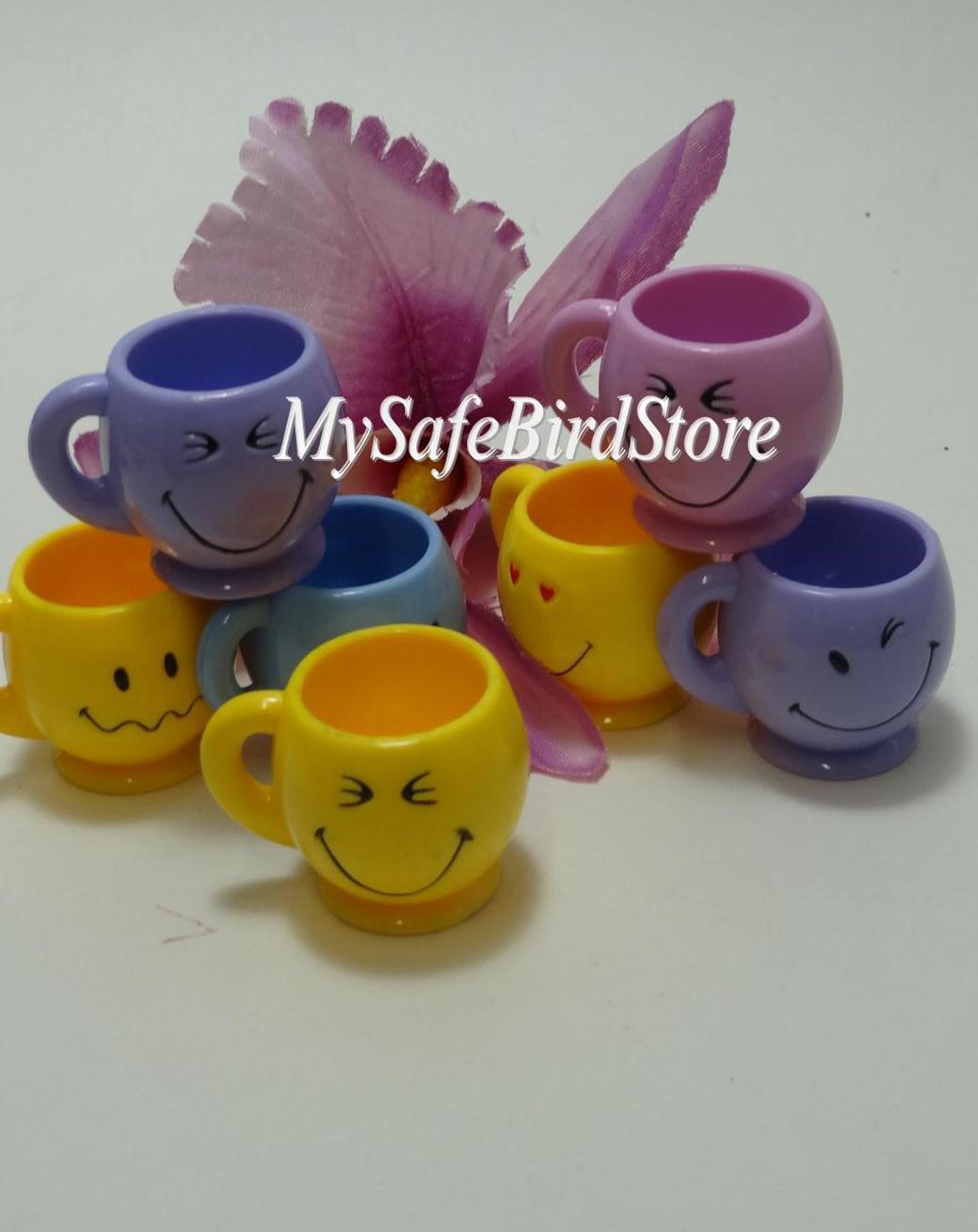
Foraging with fresh food is a bit harder, but it does not need to be. For example, why not get several of these mugs from My Safe Bird Store.


(Go HERE for the mugs)

or for large parrots/those not safe with plastic, these mini stainless steel pails from The Bird Safe Store.
(Go HERE for pails)

Distribute your fresh food, be it mash or whatever, among the mungs, and hang them, just alone by themselves with a hook on the handle, around the cage. Easy! Fill 3, 4, 5, however many, and just hang wherever, from the middle of the top bars, on the side bars, from a toy, top to bottom, all over. Start slow, and keep moving them to harder places to reach. Trust me, your parrots will figure it out, they do not need everything handed to them! It may take encouragement in the beginning, but it will be wonderful when they get the hang of it, just like we feel better after we take control of our own life and start doing things more for ourselves, moving around, exploring. And climbing all over for each little bit, hanging upside down, going to the cage bottom, that is all foraging, not to mention a bit of exercise. Plus, it is really not any harder than dishing the food all in to one or two dishes.

Saturday, June 2, 2012

If you have questions about behavior problems.....

You might want to ask Lara Joseph! I really love the post she did today helping out a woman that wrote her about her trouble with her young macaw. Anyone that has even glanced at any of my other posts knows that I could go on and on and on and on for ages about behavior and training. I know you just read that sentence and  changed the word "behavior" to "absolutely anything in the world" but that is not true! Besides which, I am talking about behavior now, and will not be going on and on, since I think Lara said it all perfectly. And if you have a parrot, or are thinking about getting a parrot, or have had multiple parrots for many many years, I highly recommend you head over to Lara's blog and read not just today's incredible post, but also the rest of her blog!

And just in case you somehow missed all the links I peppered that short paragraph with, I will give you one more chance to get there- larajoseph.wordpress.com

Sunday, May 27, 2012

One-line Problems? So Passe

I am sure everyone has heard about the dreaded hormones with parrots. Most of you will even have researched about the dreaded hormone issue. Many of you have likely personally experienced the dreaded hormone issue. The question is, should any "angry", "antsy", "annoying" or "not-my-sweet-little-cuddle-bunches-darling-prince-sparkles-love-of-my-life" behavior automatically be considered hormones?

Firstly, branding behavior as hormones can be just as much a problem as branding behavior, as, oh say, just a broken parrot. Why? Because once a behavior is branded (i.e, one-lined), it is often considered consciously or not to be solved, when there may actually be both a reason for the behavior and something that can be done about it.- although that will usually involve changing your own behavior, so consider yourself forewarned.

Take this as an example:
Let's say you got an adorable male amazon, perhaps even an adorable double yellow headed male amazon as a baby. You have had him for a of couple years, and little Joe is now becoming a mature parrot, about the age hormones can start to be a problem. One day he bites you, totally out of the blue, and is no longer very cooperative about getting out of his cage. He starts yelling a lot soon after, and tearing around his cage like a madman (or bird) so you know at this point that the problem is hormones, so famously a problem in the "hot three" amazon males, and you will have to give him lots of toys and wait it out, being patient with him, moderating his daylight hours, etc., right?

Well how about another look at this story:
Since you brought Joe home as an adorable little baby, he has let you do anything with him. You never really trained him to step-up, and always just reached in and stuck you hand under his feet whenever you wanted to get him out; you used the same method to move him from any area to another. Joe is a sweet guy, and seems to love doing just about anything. Occasionally he is not quite as willing as other times, but you know he loves being with you as much as you love being with him, so you get him to do whatever you want anyway- like get out of his cage when he is busy playing, because you want to take him in the shower with you.

Everything is going so well, and you so adore little Joe, that as the years go by, you do not notice the subtle signals Joe is giving you that he would rather not be [essentially] forced to mold his schedule to yours, or that he might rather finish playing before coming out, or perhaps is tired of having most or all of his choices made for him- which is something most humans dislike, as well. First he just leans back when you go to pick him up, or grips his perch more, then he tries moving away from your hand, looking away from your hand, trying everything he can to tell you politely that he is not interested, perhaps even "play attacking" your hand. You mean well, that is quite true, and Joe I am sure knows this, but he cannot seem to get through to you that he would like a two-way relationship!

Joe finally reaches the point that he is so irritated with you that he bites your hand as he sees it coming in to get him again. And this time, you respond! You take your hand out, and go away! Yay! Joe is so happy to have a communication method now, and knows that biting will work although nothing else does. So he starts biting to communicate his messages, and you needless to say are not able to get him out of the cage very often. Being in the cage more, however, is no fun, so Joe gets "cage fever" and starts screaming more, and seems so antsy inside his cage, tired of the same little box.


The Point?
This example is made up, but actually fairly common. Yes, it is full of behavior branding, but that is to get the point across- very difficult to tell a story from the parrot's hypothetical point of view without it! Not all parrots will become raging balls of hormones when they mature. But pretty much, they will all change. Joe may or may not become a raging ball of hormones at some point, but in this story, he is not so much hormonal as he is simply an adult trying to state his rights and decide on his place in the world.

From a behavior standpoint, even with what you are sure are hormones (like a female laying eggs and building nests, or a male feeding everything) you need to resist the urge to brand the behavior. Look at the behavior as you would any other, as there are often still things you can do to make life easier and more pleasant for all. Formal training of some kind will always help. It redirects their attention to something else, something rewarding, and allows you to interact with them in a safe way- you can even train parrots that are not safe to let out of the cage. Things like target training, or taking an object and dropping it in a bucket, etc, are all trainable with bars in between you and your parrot.

Most importantly, while every one needs to be aware of how hormones can affect your parrot, and therefore your life, and aware of the fact that all parrots will change in some way as they become an adult, you should not let that knowledge prevent you from finding solutions to the problem currently at hand.

Friday, May 11, 2012

Why are you doing that??


Ohhh, of course darling, we know all about behavior.......
like I was just telling Peter, simply fascinating!


Something to think about:

1.  Why are you doing whatever you are doing right now? At least one of those things is reading this post, I know (smart, aren't I?) so I will use that. I know you are not reading this post instinctively.... even if you are not absorbing anything at this moment (this would be the point in the conversation my Mom would throw in "and then the dog drove to the store" to catch my Dad) at some point you starting reading my blog for a reason. I doubt it was because it was here, otherwise my readership would be over 7 billion, very impressive if I do say so myself, but not true. So perhaps it is because you have a parrot, reasonable enough, or would like one. That does not mean you inherently will read everything on parrots, plenty of people with parrots do not. So I can without too huge a leap assume it is because you are interested in parrots, or that you wanted to change something about your parrot, or about yourself in reference to your parrot, like care, etc. Going deeper, why are you interested in parrots, or why do you care to spend time changing something? Could it be you get pleasure out of learning more, or pleasure from the parrot, and therefore wish to improve their life? Or could it be that your parrot is driving you crazy, and you wish to change that- but then, why change it rather than re-home the parrot? Could it be for some reason you enjoy being around/having them?

This is the gold nugget in the bottom of that pan- you are doing the behavior, in this case reading my blog, for a reward!

Got it? Reading my blog is a behavior, and there is a reason for this behavior.


"bathing" in the food dish:

I have my reasons.........


2.  Look at any other area in your life. Can you really think of something that you do for no reason? If you can do it, it is a behavior. Period. There are various reasons for behaviors, and your reason may be quite unusual, or even non-discernible to yourself, but there is one. If you hate your job, why do you work? For money, or if an internship, to get money later (complex thinking, that, looking to the future!) It is easy to point out gold stars or ice cream cones as rewards for children, or bribes for adults (and yes, sometimes those two examples mix) but those are hardly the only time rewards are handed out, far from it. And likewise, there are many more punishments than being spanked for doing x as a child, or getting a speeding ticket for going too fast.

-Your reason for eating breakfast could be to stop being hungry (negative punishment, the removal of something unpleasant because of the behavior)
-or because you feel so much more awake after eating (positive reinforcement, adding something desired because of the behavior) 
- but if you take too long eating your continental breakfast you will be late for whatever it is you do (positive punishment, adding something undesired because of the behavior) 
- while if you eat all your dinner leftovers for breakfast, you will have none for lunch (negative reinforcement, the removal of something pleasant because of the behavior)

Got that? Looking at this, I can tell that I have learned to eat breakfast for two reasons, and what to eat for another two. Throw away what you think these four behavior terms should mean. You just need to know four meanings: negative is subtraction (the removal of x) positive is addition (adding X); punishment is something you dislike (even if someone else likes it) and reinforcement is something you like (even if others hate it.) So mix those four terms, and you have the four reasons for a behavior to continue, or to die out.


Floofing my feathers:

I feel more comfortable with them all in place!


Complex stuff, behavior. But not unreachable! There is a reason for your parrot's behavior just as there is for yours, just as there is for every living creature. Anything you can do is a behavior, and there is always a reason for any behavior that continues. Very important to remember, though, it might NOT be what you think is logical- if the behavior continues, there is still a reason. Period.


I miss you, budgies. Rest in Peace.

Tuesday, April 3, 2012

Friends? Pretty Please?


Despite the fact that I do like to keep my birds in pairs, something that will always carry inherent risks, I consider myself fairly cautious about allowing any of my parrots to be together. Then again, since many people, such as one of my past vets, think keeping birds together at all can be quite dangerous and should be preferably avoided, maybe I am actually a reckless caretaker. Who knows. What I do know is that whatever the risk, my birds are much happier with friends. There have been disasters before (think Peter and Ava) but I just cannot really regret the situation which allowed the fight, and though I can hardly speak for any of my birds, I am not sure Ava necessarily regrets her life up until he flipped, either.


Let me be clear- I do not think anyone should get a parrot they do not want. Before getting any parrot, any bird at all, you need to think through how it could change your household, as well as how it definitely will; costs, mess, etc, are things that will always be there, at least. I mean really think about it. When I say a friend for your parrot is a good idea to consider, I mean it is a good idea to consider AFTER you have already decided to get another parrot. If you have decided another parrot is something you are prepared for, it is then I strongly recommend looking at the option of another of the same species.

However, I do not just throw any birds together and hope for the best. There are many fine people in this world, even some I admire, that I would likely try to kill (assuming my hatred of violence suddenly dissipated) were I forced to live with them. Sad fact. I see no reason why we should think animals, and in this case parrots, are any different. It is somewhat easier with flock parrots, like budgies and some conures for example, as they are small enough to have a fair amount of room in a standard flight cage and are pretty good at getting along with others though they may not be their heart's desire- think roommates. Contrary to popular opinion, though, many parrots do not naturally stay in flocks, and would in the wild spend most of their lives just with their intimate family- their partner, chicks, and not-quite-mature young. This means they do not generally take kindly to the idea of a roommate, since all they are looking for is "the one", so to speak. And, getting back to the first sentence in this paragraph, you can understand why getting another parrot, even of the same species and opposite sex, and expecting them to be "best best!" friends can be quite chancy. They may, and they may not. You have to be prepared for either outcome.

Yes, this has picture been posted before, 
but if you do not think it is cute enough for a re-post.....
there is just no hope for you.

I am perhaps more fortunate than the average parrot caretaker in the ability to search and find friends for my parrots. Since I foster, if I think one of my foster parrots might work out with one of my own, I can introduce them after quarantine and find out. Obviously, this is not an option for everyone, but it may be more of an option than you think. If there is a rescue near you that fosters out, such as Phoenix Landing, you may be able to try this for yourself. If the foster does not work out, you are still helping them get to a wonderful home. If fostering is not an option, carefully evaluate your parrot. Do you know whether they were ever socialized with other parrots, particularly those of their own species? Were they hand-fed from a young age? Do they play well on their own, or are they severely attached to you or another person? What is their general personality, and what personality do you think would mix well with them? These questions, save for the first two, are just guessing, but they will certainly improve your chances rather than a shot in the dark.


Frank was not socialized, was totally hand fed, and is a hyper active, very sensitive (formerly often depressed) special dude. Lola seemed a good match. Because of Frank, I had to decide what seemed to work and try it over several months, since Frank was not going to be able to make friends quickly. And yes, I was prepared to have a second quaker he could not be with. Back to Lola- she was older, calm, confident, and somewhat maternal. Most importantly, she knew she was a bird, and (shocker!) a quaker at that. I was hoping watching another quaker would help Frank, I could hardly imagine both how close they would become, and more surprising still, how much it would help Frank; he is a totally different bird now, and clearly very happy.

Clementine has quite surprisingly become good friends with the ekkies. She has been around many different birds throughout her life, including several other greys, but she never took to any of them and would attack if they got too close. Therefore, I was not planning on allowing her out with any of my parrots, even when she showed such interested in the ekkies, and they seemed to return her long-distance friendship. Chester took an almost immediate liking to her from across the room, which considering he has an even worse attack bird history, is very surprising. After several months of talking to and mimicking each other from their respective cages (and turning the bird room into a real college cafe in the process, seriously) Chester stole over to Clementine's cage one time when I was [practically standing on my head in a very unique and previously unknown yoga position] cleaning his own cage. Needless to say, I was a bit stunned to turn around and find him feeding her through the bars. I also lifted the ban on time out together, so now all three play quite happily on the play gyms and tree! You just never know, do you?

By the way, I do not recommend ever allowing one bird to "corner" another,
as in this picture, even if they are getting along. There should always 
be an escape route. Below the bottom of the frame 
is another perch Clementine could easily reach, 
but I moved her anyway after shooting this, just to be safe.

Tuesday, March 13, 2012

Please and Thank You

With help from Linus

What qualifies as a well-behaved parrot is always going to vary from person to person. And how to achieve whatever your definition of a well-behaved parrot is will also vary widely. I am not going to get in to that fray in this post, after all, I intend this to be a short(ish) one. So instead, I will focus on a simple way to get a little closer to that goal.

And just a note, this post applies only to parrots that in general very much appreciate interacting with humans and will actively seek it out from you or another human. It does not apply to those that have not learned to love human companionship yet, and especially not to those that are distrustful of humans.


Whenever you go to interact in any way with your parrot, stop first and see what they are doing, ie, their behavior. If you want to encourage that behavior, such as playing alone, then go ahead and greet your parrot and continue with whatever you planned to do. More important than ignoring the bad is praising the good. Even for birds that have no glaring issues this is extremely important. How else will they know what you want? Even more than talking and doing tricks, a parrot that plays well on its own, is not overly loud, is friendly, and eats a varied diet is highly desired. So why just praise the talking and tricks? Praise the little stuff, since a parrot that does not wave on cue can still live in harmony with you, but a parrot that does not play? Not so much.

Going further, whenever I can, I will ask for a behavior before giving attention or food. In fact, many of you likely already do this by asking your parrot to step-up. Any time you request a simple behavior which they already can do before giving them what they want, ie attention, is a step in the right direction. Not only does this empower your parrot by allowing them the opportunity to shine (or not, if they choose), but it also gets both you and your parrot in the training mode. If you have a parrot that does not really like new toys, and you get them to beak a toy before picking them up, then the toy soon becomes associated with you and fun. Just as important, the idea that certain behaviors are rewarded is instilled at the same time, so if you choose several little things you can do throughout the day, your parrot will not only learn them, but also be on the lookout for new ones.


And last bit of advice on this subject? If you ask for said behavior (assuming they do indeed know the behavior), like step-up or as per my example beak the toy, and it is not given, you need to walk away. Really. Just walk away. I know you want to play with them, but you will send mixed messages by going ahead with that now. Once a behavior is asked for, if the request is refused, then giving in will weaken that request greatly. If you are consistent, you will very quickly find the only time you are refused is when your parrot genuinely does not want to play. And that means you now have two-way communication. In the words of that infamous ad campaign....... priceless.


Saturday, February 25, 2012

A Deep Bond Takes Time

Almost everyone has heard about someone that has shared an intense bond with some animal companion, be it a parrot, dog, goat, or fish. Perhaps you have had one yourself. However, I also know many people can feel somewhat discouraged by these stories, if they do not immediately experience a true connection with their new pet. It can be very tempting to get irritated, or perhaps blame your animal, or the species of animal, as somehow not as good, as intelligent, as others. Personally, I think this is hogwash, just my opinion. Those that have an immediate bond, and one that is returned, not simply a one-sided human ego affair (you know when it happens, trust me) are quite lucky. However, bonds that take time to develop are no less real and no less incredible.


As an example, when I got Gwen, my then 6 year old ex-breeder chihuahua mix from the pound, she very quickly settled in with me. In fact, I was frequently told how amazing her immediate claim to me as her new person was. She was fairly protective of me, and clearly valued my company. She did not want to be far from me for long at all, and had separation anxiety. That said, it was not a deep bond. She liked me, but..... it was just not the same. I could tell, and so could close family that saw her with me a lot, that she was somewhat aloof. I was the best she had, but she was not truly bonded to me. She was taking care of herself. As an example, when I was sick, she really seemed to care less, in fact, I would get complaints if I interrupted her beauty sleep throwing up in the night- she moved off the bed and across the room, taking a blanket with her. Not exactly normal behavior for a doggie companion of an ill person, is it? Overall, throughout the day, as much as I loved her, and she seemed to like me, it was clear there was no deep bond, just a friendly friendship. So basically, she decided to like me fairly quickly, in a day or two, but for a very long time, that was as far as it got.


When I had had Gwen for about a year, I was away from her (health reason again) for about a week. Prior to that, we had never been apart for more than an hour or two, and that only a couple of times. I had continued to treat Gwen like the little princess she is for that year, and tried to get past her block, but I had had no luck. When I saw her again after being away for a week, though, that had all changed. Gwen was so excited to see me (not that I did not return the sentiment!) and it was very clear from then on that things had changed. She is no longer just a guard dog, but a personal body guard- and by this I do not mean a nippy chihuahua, just to be clear! She learned on her own that chemicals were a problem for me (or perhaps she had already known and not bothered about it) and would go on alert when she noticed something. She did not allow anyone that she felt was, erm, contaminated (speaking MCS-wise here) near me, even if they were otherwise well-loved and welcomed people. If I started to get upset, she was right there in my lap, licking me. And, just for the record, I never heard another complaint if I got sick in the night. One of her ears is always tilted towards me to listen. I could go on and on, but you get the picture. It was no longer a one-sided affair, Gwen and I were, and are, extremely, extremely close. I am not even going to begin to describe what she means to me, this blog is just not the place for that, quite frankly.


Moral of the story? Don't give up. This does apply to parrots, after all, if it took this long to bond with a friendly and loving dog, you can easily imagine a parrot could take even longer, it depends both on the individual bird as well as what he or she was been through. Claudia and I had a near instant connection that is almost eerie, whereas my bond with Yo-yo, while just as incredible, took a couple months, and some have taken even longer. I do not have such a relationship with Clementine yet, she settled in quite quickly, and we get along wonderfully just as I did with Gwen when she first arrived, so I will just wait and anything more is just gravy. Trust me, whatever side you are on about those stories of being instantly chosen, bonds formed over much longer periods, with hard work or simply a lot of patience, are just as strong, and just as life changing.


Saturday, February 11, 2012

The Ekkies Reinforce Gender Stereotypes


Stereotypes generally given to people, that is. I was just thinking  that over this week during the ekkie training sessions. Obviously I had noticed their personalities before, but this week it suddenly struck me (the things you laugh at when you live alone, right?) that they were playing right in to the oft-quoted "standard" man and woman  personalities.

Both Claudia and Chester are trained to target to a stick. This means they are to go to and touch the tip of the target stick, so I can get them to go up onto or into whatever I need them to without coercion (not really an issue with the ekkies, but useful with more difficult parrots), and even tricks like turn around, etc. It is useful for a huge number of other behaviors, so definitely something to teach. But the key thing here is that the parrot is supposed simply to touch the stick, not attack or splinter it. Optimally, the bird would not bite it at all, but that is rather a hard concept for me to get across to some birds, so I settle as long as they immediately let go on their own- no intent of playing or destroying.

Claudia very quickly picked up on the touch, not play, concept. During training, she displays unusual grace (for her, anyway) as she make her way with deliberation and great seeming concentration to the stick. She always just barely touches the stick with the tip or top of her beak. Very gentle, quite correct. Chester now... I have a bit of trouble with him! He knows the stick is not a toy, that much is clear. But to watch him during training is, well, a real treat for anyone with even a speck of humor in them. It is clear to anyone that he loves his training time- he goes charging for the stick, grunt or screech optional, heaven forbid anyone get in his way! When he gets to the stick he jumps (second grunt optional) and almost grabs the stick with his beak, occasionally giving it a little twist.  Not quite a full bite, more like a smack, but very forceful. It is always quick, and he lets go right away, and looks at me, hopping around for his treat and/or next cue. I try to move the stick quickly so he just touches barely and praise that, but he usually forgets halfway through training.


So, there you have it. Claudia, the gentle and delicate female, following directions carefully. And Chester, the rambunctious guy, using force to accomplish his task. And just for the record, Claudia wins the day- she connects the dots from task to task faster, and gets to the finish line first. But Chester gets bonus points for enthusiasm.

Friday, January 13, 2012

Be gentle now, quakers!

My quakers are not always the, erm, nicest, finger-wise, anyway. Frank, for his own personal reasons, is very unpredictable, but Lola is fairly normal, a bit grouchy with her age, and she always was cage territorial, but it should be made clear she is not in the same category as Frank! Either way, the point remains the same- how do you redirect their energy when you need them to do something and they are not in the mood? There are many methods, spoken about in length in books and online, mostly focusing on having certain behaviors so well trained that you can always fall back on them. Stick training, for instance, or a trick, such as a wave, to distract them. And while I do have to go through some of Frank s repertoire of tricks every couple of minutes when I am interacting with him to keep him engaged and in a good mood, I have one specific routine I do whenever I need to get either one in a good mood so I can move on to whatever the necessary task may be.

Both Frank and Lola love giving kisses. I had Frank first, though, so I developed this with him. I gave Frank kisses all the time when we were interacting (ie, during highly positive moments) and this eventually turned into a bit of a trick. I ask him to give me a kiss, and either offer my finger or my forehead (above the hairline- he cannot do much beak damage there) and he leans forward, touches me with his beak, and makes a kissing sound. He often initiates it himself now by asking the question. This became, and still is, above and beyond his very favorite thing in the whole world, loved more than anything else, food, head scritches, singing, clapping, anything. In fact, I now use it as a reward training other tricks! More importantly, though, because this routine is so highly valued by Frank, I can use it to get him out of a depression or break an attack rampage, or get him away from something he should not be chewing on. He really loves it that much! I have now added another version of the kiss game, so when he shakes my finger, I tell him to be a gentleman, and he leans down and gives my finger a kiss while still holding it. Sometimes he gets a bit carried away, though, and becomes positively French (or Italian?) giving me many kisses up and down my finger! Hard to believe he is the same bird that can be so unpredictable and rather dangerous.

Lola, like many parrots, also came knowing a kiss sound. Hers was different from Frank, and she loves getting lots of little whispering kisses in a row, to which she responds by bouncing her head from side to side, looking at you with first one eye and then the other, while imitating you with her own kisses. She still loves this, it is one of our special things to do together. However, through Frank, she learned the kiss game, and now loves it (almost) as much as he does. I can not say whether it would convince her to stop chewing on an electrical cord, since she is so well behaved anyway, but it does get her to stop protecting her cage or Frank so vigorously so I can pick either one up or mess with their cage!

As you can well imagine, the kiss game has huge cuteness factor. I mean, is their anything cuter than a little green fluff ball leaning over and giving you a big kiss? Yes, my friends there is- a little green fluff ball asking his beloved (other) little green fluff ball if she would like a kiss, before leaning over a giving her one. That certainly takes the cake!

Friday, December 30, 2011

Reflection for the New Year

I do not often write too much about myself specifically on this blog. I am a rather private person, quite frankly. But these past few years have been rather hard for all of us here. My health deterioted drastically, and my MCS became much worse. I had to move around several times, but never had a very healthy place for myself to live. Each place I got worse in, and had to move on to another in a continual downward cycle. Often I was unable to walk, and for 8 months I could not even hold my head up on my own. For a while I lived in a stripped, cleaned, and remodeled Airstream. It has been hard. I was without many of the things people in this country take for granted, and I am not even including my health in that statement. In the Airstream I did not have indoor plumbing and no hot water unless I boiled it myself. Although it is hard for people with no experience with MCS to imagine, our modern world is full of chemicals, many of which could have easily killed me, very quickly. I did not live like that by choice. I was not able to be around very much, even things like magazines were a problem. I could only see a very, very few people, countable on one hand, the only members of my family able or willing to get fully unscented and non-toxic, so to speak. Obviously, even for a somewhat loner like myself with a wonderful flock of parrots, a dog, and with access to the internet (most of the time....), that isolation takes a  a serious tole. It does not help that I am not very good at translating internet aquaintances into real friends, a fact which makes one feel even more isolated. Combine that with having a severe illness (I have no memory of ever being without pain, but these last few years have been trying even for me) and constantly having to watch for something that can end it all in a few minutes leads to one nasty stew.

Still...............

There were many things I gained from all that. Living in the Airstream in many ways could almost feel like a privilege. On the edge of the woods, with a wild field in front and beside me, I felt almost part of the landscape, and the local wildlife seemed to accept me as such. Windows in airstreams are low enough that when an animal is right outside, they really are right next to you. And I was fortunate to live in an area with abundant wildlife, from black bears, coyotes, and foxes, to eagles, osprey, and owls, song birds of all types, insect life of incredible variety, deer, the most adorbale bob white families, and all manner of smaller mammals. On top of that, being someone that already valued simplicity and disliked waste, I found it a useful experience to live without so much. It really is possible. 

Throughout most of this I had my parrots with me. I was fortunate enough to have some wonderful family members to help me look after them when I was unable to give them all, or even any, of their care. No, they were not kept in the standards I hold, but they did get my very basics (good food, toys, etc), and we stayed together. Although there were periods some had to be moved into smaller cages, they were in their big cages for much of the time, even in the airstream, which had little else besides cages! Through all this, I was rather amazed, although I felt like we had a good bond before, just how much of a flock we became. It truly shows how incredible parrots are. They all become so conscious of one another, and even more so of me. I am including Gwen in this statement, as my cat stayed with my sister through these many transitions. Even Chester, who formerly hated birds, particularly the little ones, has become rather attached to them, protective. They all talk to each other alot. We all got through it together.

This time last year I was testing a new place to live, and stayed there for 2 months, hopeful that it would work out, although in the end it did not. It was a long way away, and the trip was horrendous, so I am very glad I survived. My parrots were unable to be with me then, so they stayed, again, with my darling sister. Being away from them was quite hard, and according to my sis, they were none to happy with the situation, either. Fortunately, she is quite patient and understood their pain.

I say this all now in my new house. My new safe house. My new safe house in the mountains, with plenty of fresh air surrounding me. I have a beautiful view, and lovely yard, and am surrounded on three sides by woods with a huge and absolutely storybook perfect cow pasture in front. My closest neighbors are extremely nice, into animal rescue, and totally unscented. All of my parrots are here with me, and loving their new life. I cannot believe I made it, and I feel so fortunate. Obviously, my plans for the best possible captive parrot environment (in a home, I mean) are huge. They are slow going, but we will ge there. But more importantly, after being here several months, I am already so much better, and with my new treatment and program, hope to be far better very soon. I can do so much more, and really give my parrots what I want them to have. For one thing, they all have room to fly here, even Miss Claudia!

Since coming here I have adopted a starving English Shepherd puppy. And against my initial better judgement (which turned out to be false, for once) a wonderful African Grey, whom I will introduce soon. I hope to start fostering again soon as well. In fact, one of the people who worked on the house, before I came here, is rather desperate for me to take their cockatoo. My MCS is getting better, and I hope to be going places and seeing people more. And I just cannot say thanks enough for all of this, and most importantly, for my parrots and dear Gwen. I would not be here without them, and although they seem content enough just being with me, I feel obliged to make it up to them as well as I can. Being part of a such a flock (and who knew there could be such a close band of such a group of misfits from different continents and animal kingdoms?) is truly amazing.

So, here's to 2012. I hope the rest of you have as much good luck in this next year as I have had in this one!

Monday, November 7, 2011

If you could no longer keep your parrot, would she become a rescue?

I am a sure all of you have been told, or have told someone, that adopting a bird means assigning yourself a job or frustration, irritation, and perhaps heartache. After all, birds in  need of new homes are *almost* all terribly,  how shall I put this, messed up? Right? Sure, there are a very very few that are not, but for the most part, a bird needing a new home is a bird with lots of baggage. Perhaps they cannot ever be turned around. Just think of what they have been through, living out their life in a home besides your own!

Ok, so maybe that was a bit heavy on sarcasm. What can I say, it is a strong streak in my personality. However, I think you do get the point. If not, here is another way to look at it.

At some point, most of us will have to find a new home for our larger parrots, if not our smaller ones, as well. They can live a very, very long time, and may very well outlive us. This is ignoring any other life circumstances that may force us to consider the unthinkable, as you never know what life will throw at you. However, the point is, if you needed to find one or all of your parrots a new home, would you want the potential new caretakers to consider your birds as rescues that must be full of baggage? Perhaps they prefer a different diet for their parrots, or prefer a different type of toy. Do you think your birds are going to cause a lot of trouble for their new home? Or do you think they will adjust to the new life and new people, and continue on being their sweet (or not so sweet  as the case may be) little selves?

Perhaps you know someone else that has a parrot, or many parrots. If they could no longer keep them, would you consider their parrots to be rescues, full of baggage?

Parrots are very, very resilient animals and that should never be forgotten. It can be discussed innumerable times how cockatoos are so sensitive, and ekkies always pluck, and conures are nippy, and the little guys, budgies, tiels, etc., do not like change (and please do not think I agree with all these stereotypes) but the bottom line is that parrots, all species and sizes, really can have quite a lot thrown at them and still come out on top. A little time and a little understanding, nothing major, goes a long way. Being perfect has nothing to do with it. All parrot caretakers make mistakes and will do something not to be, ehem, behaviorally admired at some point. Just relax, take a deep breath, apologize (I mean that now!) and move on. Start over from the beginning if need be, but just relax. Like people, parrots get it. And they know if you are truly trying to listen and respond accordingly.

Even from the very worst situations, parrots can rebound and amaze you no end. You got a parrot because they are such amazing creatures, so please, don't take that same credit away from those that need a new home. They really are the same as your own.

Saturday, October 1, 2011

Amazon Companionship Study

I find this study on young amazon parrots very interesting. You must be a member to read the full text, but the abstract is more than enough to give any parrot (or other bird) keeper plenty of food for thought. Whether parrots should be kept in pairs for their own happiness, whether parrots kept in pairs have fewer behavior problems, whether paired parrots are better/worse companions, etc., are all issues that anyone keeping parrots for very long at all has come across, very likely in the form of a heated argument or at the very least a strongly voiced opinion, one that often verges on or fully embraces a warpath. All that debate comes with good reason, as there are legitimate points on both sides. However, I am not going to try to hide the fact that I think parrots are happier and better off if they can be kept with a compatible friend or mate!

Please, though, if you are thinking about going out and getting a friend for any of your parrots, from a budgie to a macaw, remember that like people, birds will not get along with every bird. They pick their friends as well as their mates. Also, if you parrot has been kept without any other bird for a long time, or was raised away from other birds, they may not recognize other parrots of even the same species as potential friends at all. The Amazon parrots in this study were parent raised (and note that they were being handled regularly by humans, and seeming to enjoy doing such), which makes a huge difference as they not only know they are parrots and know how to interact with other parrots. This is not to say, though, that it is impossible to get a friend for a single parrot! Even if they are not allowed to play together, just having another parrot in the room can be very rewarding for parrots. Parrots in the wild will not eat alone, sleep alone, or do anything else alone! With another parrot (I admit I think same species or compatible species from the same geographic area and/or similar size is best) they will have someone to be with all the time.

Studies like this are important because they show what could be possible if you applied knowledge to raise better parrots from the beginning, in this case keeping them in pairs from the start, instead of trying to fix problems later after they occur.

If a person has an untamed pair of parrots, either a small or large species, and much prefers tame cuddly parrots, they will be fully convinced the only good companion parrots are kept singly. On the other hand, many people have mated pairs of parrots, again from the very small to the very large, that are still wonderful and tame and very interested in people (and sometimes still enjoying scritches as well), so naturally they will have a very different view of things. My point? I try very hard not to put out statements based solely on my own experience. Most people only have experience in their own home with one parrot of a species, possibly two or three of that species. That really is very little to go on, and while individual experiences taken along with individual circumstances can be, collectively, very important and extremely useful, each piece on its own is not nearly so valuable, and can be very misleading. That makes studies like this, as rare as they are, even more important as a tool to cut through that cloud. The parrots are raised and kept under the same conditions, making comparisons possible that give the rest of us something to go on, and apply in our own homes.

And to reiterate, please go read this article! It is not very long, so really, please read it.

Sunday, March 13, 2011

Oh No, Hormones!

Yes folks, we are nearing that time of year again, a time when life as we know it is turned on its end and we feel our sanity seeping away, as eggs, frustration, and unbelievable volume mesh into one chaotic color wheel. Or that is what I was thinking this morning in bed, as Linus started his day-long deluge just moments before the sun came up. I am not talking a bit of happy-to-see-the-day singing, no, that is usual, and consists of a few loud calls, some beeps and tweets, and lots of (very pleasant) whistling. Who could complain about that? No, this is different- just one loud, high pitched call that will continue intermittently (but seemingly non-stop) throughout the day. This, my friends, is Spring.

Please, though, do not get the wrong idea- Linus is perhaps the best prepared, but he is certainly not the only one getting ready for the 20th. Frank and Lola are louder, more exuberant, seemingly bursting with joy, even if their expression of said joy doesn't always give me the same warm fuzzy feeling inside. Yo-yo and Miss Patty are clearly thinking nest-wise, although no sign of serious egg production quite yet. It was only about a month ago Miss Patty laid an egg (just one, she doesn't often lay more now as they tire her so) so I am hoping they will see the food abundance and decide to be fashionably late. I will take any time I can get before more egg stress! After the calling comes the aggression. Yo-yo is already started to get riled up with Linus, and, a true first, I noticed him picking on Miss Patty yesterday in a most un-pleasant manner. As of yet, they are still mostly friends, but the beginnings of another serious family feud are clearly underfoot. I can hardly wait.

Still, there is always the positive in a flock as large as mine- Claudia and Chester get hormonal in the fall instead of the Spring, as they are driven more by their inner calendar to give them the time of year to breed (fall is spring in Indonesia) rather than the changing of the season here, as is common with ekkies more so than many other species. And while that does mean I get hormone surges twice a year instead of once, I find it easier to deal with the hormones of part of my flock if the other part is still same-old same-old. Plus, Chester and Claudia are, in parrot terms, fairly mild hormones-wise. Chester is louder, Claudia starts digging on her cage floor considering the feasibility of laying a clutch, and both want more food and a bit more time alone in their cage destroying every toy in sight. Oddly enough, they also get along a lot less, so play-dates are shorter. That is really about it, though, so I don't know how I got so incredibly lucky!

For those of you that have been keeping tally, you might have noticed I have yet to mention one parrot: little Ava, the queen bee. Her "Spring Fling" is marked by a lot of napping. She is right in the middle of hormone heaven, where everything is a constant contest and every move is watched for hidden meaning. She really doesn't get into all this stress, and even if the very early morning until late at night scream fest didn't disrupt her beauty sleep, there really is only way one to get through it- sleep!

Sunday, November 28, 2010

Do your parrots grate on your nerves?

Not all the time, of course, or why would you keep them? But is there some action or behavior they engage in, repeatedly, that just about Drives. You. Up. The. Wall.? Don't try to hide it, I can feel you all thinking exasperated thoughts after reading that sentence, you know what I mean. I could use this post to give ways to eliminate or decrease this behavior, but instead, I will just suggest you read these articles and use this post to whine. I am, after all, only human. Not parrot, as my guys are always ready to remind me any time they feel I get "too high on the horse."

Any of you that have quakers should know the quaker alarm call. While it may not be any louder than any other quaker yell, it really gets on my nerves. Actually, any alarm call does that, perhaps because they are so urgent sounding. The quakers use theirs a lot, though, and I mean a lot. At first, I assumed this was due to actual alarm, but I am now seriously considering the idea that it is all a ruse to add excitement to the day, and make the rest of us look silly in the process.

When I first got Frank, he was very afraid of anything new(ish) or (even just possibly) unknown. Many parrots are like this, nothing very novel; I worked with him on getting used to new things, and over time he got much better. Eventually I reached my original goal of being able rotate toys daily, and bring in almost anything without his fearing it as long as I was calm about it and reassured him. Occasionally we would still hit something that scared him, and of course he would still worry when he saw something outside that looked potentially dangerous, but this was all to be expected. When I got Lola, she seemed to fear little. She didn't pay attention to much, but I didn't notice any fear behaviors.

Together, though, they periodically become great scardy-cats (or quakers.) The first time this happened, the alarm calls gradually increased in frequency, leaving me quite stumped. What on earth happened? Why were such normal events causing fear? I hadn't changed the food dish, why did they yell when I brought it in? They still loved the food, as soon as I got to the cage they recovered, peeled themselves off the back wall, and got ready to shove their head in the dish as soon as part of it entered the cage. Could I really be scaring them that much?

I started working with them again, and while a little back-of-my-mind thought that this was some sort of joke occasionally occurred, I kept going and eventually the "fear" went away. Except not for good. Many months later it returned. And was it just my imagination they were having a hard time keeping from blowing their cover by laughing at me outright?

Repeat last paragraph. And again. And again.

You get the picture. I hate to jump to conclusions, or risk anthropomorphizing in some way too much, but I am now very suspicious I am the fool in this scenario. And with that nagging thought comes a growing urge to do something drastic when they start screaming at my skirt, the same one they were playing on yesterday so happily. An urge to scream, or throw their cage outside (which, by the way, is physically impossible) or perhaps jump up and down like a lemur. However, I always resist; I let those thoughts come and let go of them as soon as I can, and take a few deep breathes. I can't say for sure why this alarm stage keeps repeating itself. I have to be patient. Understanding. Calm.

Seriously though, is it just my imagination, or are they laughing at me??